Library › First editions
The Book of Mormon
Palmyra, New York, 1830
Free. No account. It remembers where you stopped.
590Pages
21h 53mNarration
270,845Words
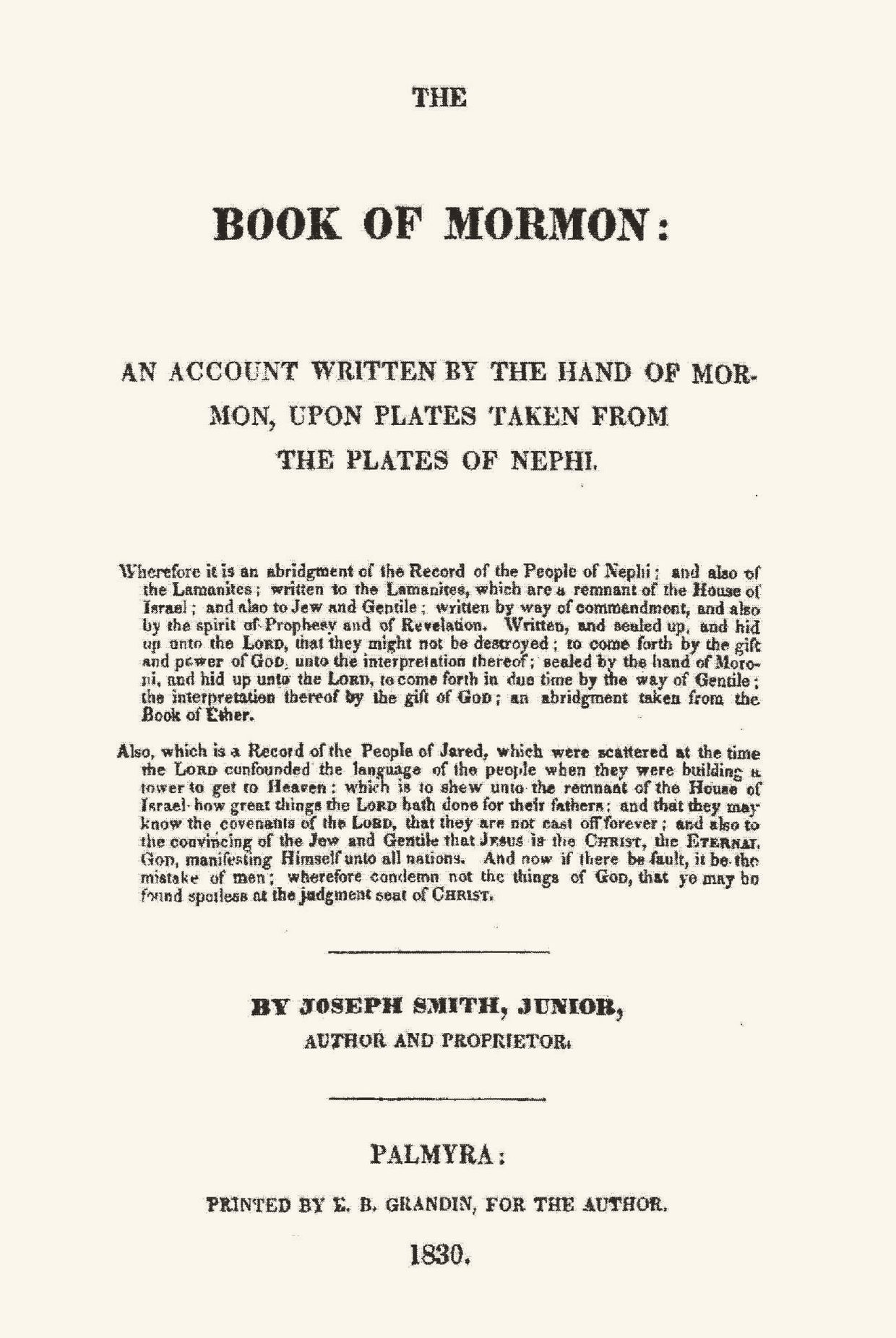
The title page, as printed
Library › First editions
Palmyra, New York, 1830
Free. No account. It remembers where you stopped.
The title page, as printed
What this is
This is the Book of Mormon as it first existed as an object: 590 pages, set in type by hand, printed and bound in a small town in western New York in 1830.
It has no verses. No footnotes. No cross references. No chapter summaries. The chapters are long, and the text runs on in continuous paragraphs, closer to a novel than to the double columned edition most readers know. Whatever a reader thinks of the book, this is the form in which it first met the world, and it reads differently in that form.
The printing
Egbert B. Grandin was a printer in Palmyra, twenty three years old, who had bought the local newspaper and its press. He agreed to print five thousand copies for three thousand dollars.
Martin Harris secured the debt against his farm. He sold a large part of it to pay for the printing.
Typesetting began in August 1829 and the finished book went on sale on 26 March 1830. Eight months, by hand, one letter at a time.
The chief compositor was John H. Gilbert, who set most of the book and who supplied its punctuation, the manuscript he worked from having almost none.
The errors
Eight months of hand composition at speed leaves marks. Comparing what is printed against what was read aloud turns up more than a hundred places where a letter is wrong, doubled, dropped or upside down.
They are on the sheet, so they stay on the sheet, and the readable text follows the page exactly. The narration does not. A broken piece of type is a fact about a printing shop, not about English, and nobody in 1830 pronounced it.
Reading it
The scanned sheet. It turns by itself when the narration reaches the foot of the page, and you can turn it by hand at any point without the sound moving.
The same words in type you can read on a phone, spelling untouched, with the sentence being spoken marked as you listen. Both text and page can be enlarged.
Switch between them in the middle of a sentence and you land in the same place. There is one reading, and two ways to follow it.
Close the tab and come back next week. It resumes where you stopped. Every page also has its own address, so a passage can be linked to or cited.
Bibliographic note
| Edition | First edition. Palmyra, New York: printed by E. B. Grandin, for the author, 1830. |
|---|---|
| Page images | From the copy digitised by the Internet Archive, item BookOfMormon18301Palmyra. 589 sheets were scanned. |
| Known gaps | Two leaves are absent from that scan set: the copyright page, and the second half of the preface. Both are marked in the facsimile with a printed notice in their place, so a reader knows the gap is in the source and not in the site. Their text is complete in the readable view and is read aloud. |
| Image treatment | Each page has been letterboxed to a common frame so the leaf does not jump as it turns, and tinted uniformly to a warm paper tone. Nothing has been sharpened, cleaned or reconstructed. |
| Transcription | Prepared by James R. Cooper, following the printed page exactly, including its errors. |
| Page positions | Taken from the page divisions recorded in the Joseph Smith Papers transcription. A page break is a fact about a physical object. |
| Narration | 119 files, 21 hours 53 minutes. Produced using ElevenLabs. Not the author's own voice. |
| Errata | Every place where the printed page and the reading differ has been recorded. Each is being checked against the facsimile before it is published as an error. |