As First Printed

As First Printed

Open the book. Tap once. It reads itself, and the page turns to keep up.

Foundational Restoration texts in the form they actually took when they were printed, page by page, with the reading running alongside.

Free to read · No account · No advertising

See it

Two ways to follow the same reading

The facsimile
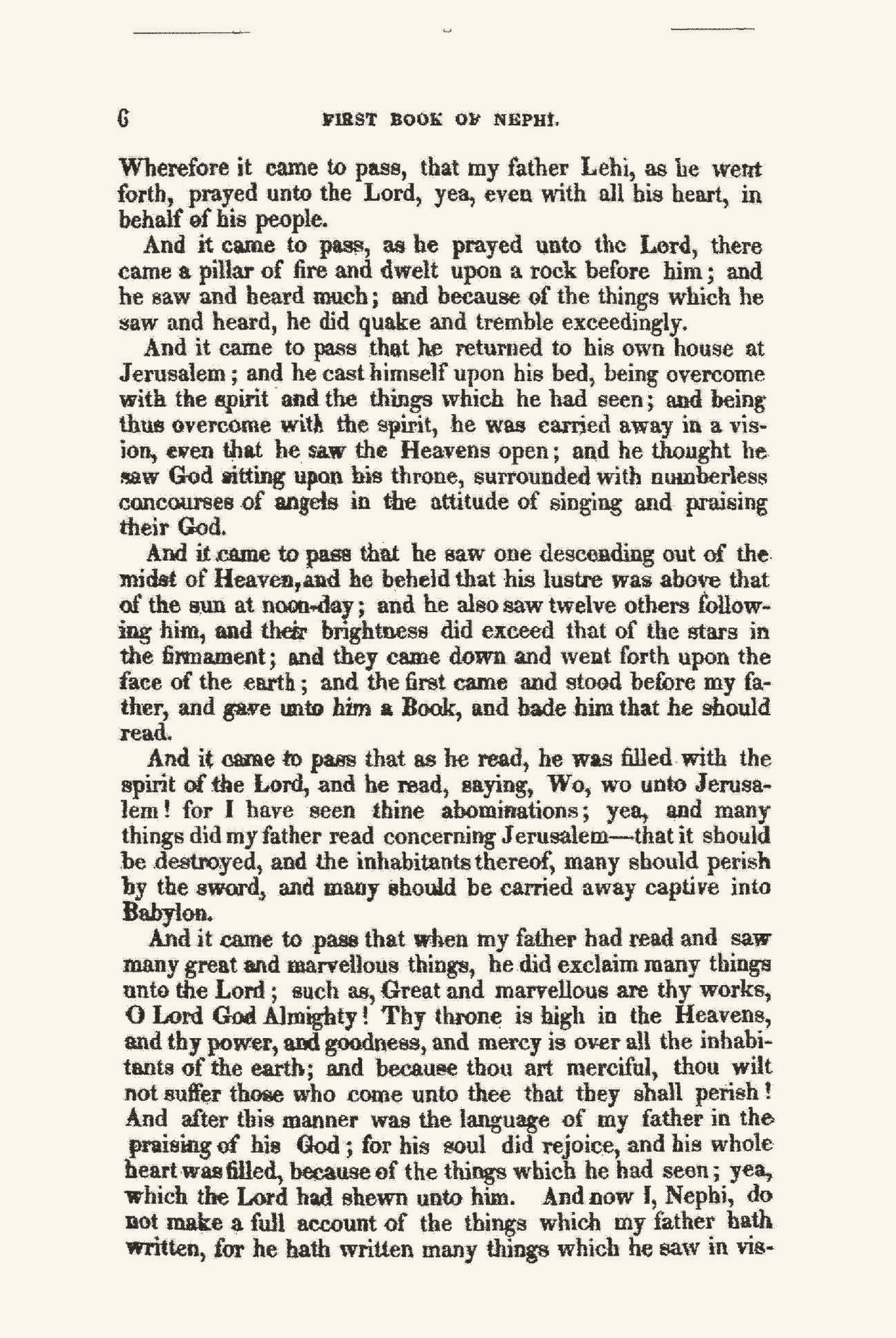
Page 6 of the 1830 Book of Mormon as printed

The sheet as it came off Grandin's press in Palmyra, 1830. It turns by itself when the narration reaches the foot of the page.

The same page, set to be read

Wherefore it came to pass, that my father Lehi, as he went forth, prayed unto the Lord, yea, even with all his heart, in behalf of his people.

And it came to pass, as he prayed unto the Lord, there came a pillar of fire and dwelt upon a rock before him; and he saw and heard much; and because of the things which he saw and heard, he did quake and tremble exceedingly.

And it came to pass that he returned to his own house at Jerusalem; and he cast himself upon his bed, being overcome with the spirit and the things which he had seen; and being thus overcome with the spirit, he was carried away in a vision, even that he saw the Heavens open; and he thought he saw God sitting upon his throne, surrounded with numberless concourses of angels in the attitude of singing and praising their God.

And it came to pass that he saw one descending out of the midst of Heaven, and he beheld that his lustre was above that of the sun at noon-day; and he also saw twelve others following him, and their brightness did exceed that of the stars in the firmament; and they came down and went forth upon the face of the earth; and the first came and stood before my father, and gave unto him a Book, and bade him that he should read.

And it came to pass that as he read, he was filled with the spirit of the Lord, and he read, saying, Wo, wo unto Jerusalem! for I have seen thine abominations; yea, and many things did my father read concerning Jerusalem—that it should be destroyed, and the inhabitants thereof, many should perish by the sword, and many should be carried away captive into Babylon.

And it came to pass that when my father had read and saw many great and marvellous things, he did exclaim many things unto the Lord; such as, Great and marvellous are thy works, O Lord God Almighty!

Thy throne is high in the Heavens, and thy power, and goodness, and mercy is over all the inhabitants of the earth; and because thou art merciful, thou wilt not suffer those who come unto thee that they shall perish!

And after this manner was the language of my father in the praising of his God; for his soul did rejoice, and his whole heart was filled, because of the things which he had seen; yea, which the Lord had shewn unto him.

And now I, Nephi, do not make a full account of the things which my father hath written, for he hath written many things which he saw in vis

The same page, word for word, in type you can read on a phone. The spelling is untouched. The sentence being spoken is marked as you listen.

Open the 1830 Book of Mormon

The library

Four printed books. Two records that were never printed.

The four books were set in type, printed and bound in their own day, so this site can show you the actual sheets.

The other two were not. The King Follett discourse was spoken once, and survives only because four men in the congregation wrote down what they heard. The earliest account of the First Vision is in Joseph Smith's own handwriting, in a letterbook, and was not published in his lifetime. Both belong here. Neither is a first printing, so they are kept separate and labelled.

First editions

Books, printed and bound. Shown as the sheets themselves, and as the same words in type you can read on a phone.

The Book of Mormon

Palmyra, 1830

590 pages, complete, with twenty two hours of narration.

Ready to read

Book of Commandments

Zion, 1833

The first printing of the revelations, cut short when the press was destroyed.

In preparation

Doctrine and Covenants

Kirtland, 1835

With the seven Lectures on Faith printed complete for the first time.

Narrated, in preparation

The Pearl of Great Price

Liverpool, 1851

Franklin D. Richards's compilation, gathered for the British Saints.

In preparation

Related founding records

Handwriting, not type. Notes taken by listeners, and accounts written into letterbooks and journals. Shown as the manuscript pages themselves.

The King Follett Discourse

Nauvoo, 7 April 1844

The printed text of that August, and the four men who took notes as they listened, each read in a voice of his own.

In preparation

The First Vision accounts

1832 to 1842

Every known account, in order, including the earliest in Joseph Smith's own hand.

In preparation

Lectures on Faith

Kirtland, 1835

The seven lectures, printed complete for the first time inside the Doctrine and Covenants of that year, where they occupy pages 5 to 74. Read them there.

See the 1835

How it works

What the site actually does

01

It reads to you

One continuous reading of the whole volume. You start it once.

02

The page keeps up

The facsimile turns on its own, at the moment the reading reaches it.

03

Two doors, one reading

Switch between the printed sheet and readable type mid sentence and you land in the same place.

04

It holds your place

Close the tab. Come back in a week. It resumes where you stopped.

A note on fidelity

The page keeps its errors. The reading gives the words.

The 1830 was set by hand, at speed, by a printer working from a manuscript. It contains something over a hundred mistakes. Plaees for places. Angles for angels. A chapter heading reading Ghapter.

Those stay. They are on the sheet, and the sheet is what this site is for. The transcription follows the page exactly, error for error.

The narration does not. A broken letter is a fact about a piece of type, not about English, and nobody in 1830 pronounced it. So the reading gives the word that was meant, and where the two part company the site marks the spot and tells you why.

About the editor

Why this exists

James R. Cooper is the founder and editor of As First Printed. He is a lifelong member of The Church of Jesus Christ of Latter-day Saints and writes from within faith in the restored gospel of Jesus Christ, the doctrines restored through the Prophet Joseph Smith, and the continuing guidance of living prophets. He is the author of the Life Eternal Theology series and Theological Meditations. He approaches this work as a faithful lay member rather than as a professional historian or theologian.

As First Printed grew out of Cooper's study of the Restoration and the books through which much of it first reached the world. The Restoration came line upon line, and its printed record developed through the work of real people who set type, corrected errors, revised texts, and prepared new editions under difficult conditions. The dropped letters, misnumbered pages, altered punctuation, and later revisions do not trouble him. They make the history more human and, for him, more meaningful.

Cooper believes that mistakes do not stand outside the grace of Jesus Christ. God worked through fallible people and did not prevent every error. As with the mistakes people make in their own lives, those errors can be acknowledged honestly and reconciled through grace rather than hidden or feared. Seeing the human work behind these books has deepened Cooper's confidence in the Restoration rather than weakened it.

He also believes the original form carries weight. Many Latter-day Saints have read the Book of Mormon ten times, fifty times, or more. Very few have read the 1830 edition. It has no modern verses, footnotes, or chapter summaries. The text moves in paragraphs as a continuous narrative. That is how Joseph Smith first published it, and Cooper believes the paragraph form better reveals the narrative Mormon created. Reading the book in that form has been a different and valuable experience for him.

Other volumes on this site remain unfamiliar to many readers. Some have never heard of the Book of Commandments. Others do not know that the first Doctrine and Covenants was published in 1835 or that the Lectures on Faith were bound into it. As First Printed exists in large part to place these early Restoration volumes before ordinary readers so they can find them, read them, hear them, and understand them for themselves.

The site does not ask readers to adopt the editor's conclusions. Each volume is presented with the text and only the historical and textual notes needed to read it honestly. Cooper's own beliefs and conclusions belong on this page, not inside the books themselves.

Terms

What this costs you

Nothing. There is no account to make, no advertising, nothing measuring you as you read. Free to read, and intended to stay that way.

The historical texts are in the public domain. The transcriptions, the timing data, the recordings, the code and the site are not.